








Key takeaways
- Project management methodologies serve as structured frameworks that prevent work chaos by defining how tasks get planned, executed, monitored, and completed across different project types.
- Scrum implements Agile through timeboxed sprints with specific roles and ceremonies, whereas Kanban focuses on visualizing workflow and optimizing continuous delivery without timeboxes.
- The most effective methodology choice depends on project complexity, team skills, stakeholder involvement, and compliance requirements rather than following trends.
- Modern approaches often blend methodologies like PRINCE2 with Agile delivery to balance governance requirements with delivery speed in complex environments.
Choosing the wrong project methodology can bring organizational issues even with the best team in place. See how to match your project’s conditions to the right framework 👇
What is a Project Management Methodology?
A project management methodology defines how work gets planned and executed. It bundles principles and processes into a playbook your team can follow.
Core components of effective methodologies include:
- Governance structure with decision rights and stage controls
- Delivery life cycle approach: predictive, iterative, or Agile
- Standard practices for documentation, communication, and quality checkpoints
- Clear role definitions and responsibilities
- Change management processes
A good methodology answers questions that matter to you. Who decides what? When do you validate progress? How do you handle change? Modern frameworks like ISO 21502 emphasize tailoring over rigid templates. They encourage you to adapt practices rather than force-fit reality into inflexible structures.
When you’re considering project management methodologies and tools, recognize that the right tools can significantly enhance your chosen methodology’s effectiveness.
Why are There Various Project Management Methodologies?
Projects differ, and so do the teams running them. A compliance-heavy regulatory rollout needs traceability and formal stage gates. A startup building its first automated test suite needs speed and learning loops.
Key factors driving methodology diversity:
- Industry constraints and regulatory requirements
- Project complexity and uncertainty levels
- Team size, structure, and distribution
- Organizational culture and risk tolerance
- Skill sets and technical maturity
- Timeline pressures and budget constraints
Aerospace and medical devices operate under strict standards that demand V-model sequencing and rigorous verification. SaaS companies optimize for fast feedback and iterative delivery. A five-person QA squad can coordinate informally, but a fifty-person distributed program needs structured cadence and role clarity.
If you value predictability, traditional approaches work better. If your team prioritizes adaptability, Agile frameworks make more sense. For example, a financial services firm might blend PRINCE2 governance with Agile delivery inside stages. Understanding the types of project management methodologies available helps you select approaches that fit your needs.
When comparing project management methodologies, having the right tech stack makes all the difference. aqua cloud, an AI-driven test and requirement management solution, reinforces your approach to project management in QA environments. The platform provides a centralized repository for both manual and automated tests. Custom reports and KPI tracking give you real-time visibility into portfolio health. Executive dashboards track progress across all projects. aqua’s domain-trained AI Copilot generates comprehensive test documentation in seconds based on your existing project artifacts. Visual mapping creates full traceability between requirements and tests. aqua integrates seamlessly with tools your team already uses: Jira and Azure DevOps for project management, Jenkins for CI/CD, ServiceNow and Salesforce for workflows. Communication tools like Slack and Microsoft Teams also connect. The platform supports 14+ third-party integrations plus REST API access. Whether you run Scrum sprints with Agile boards or manage Kanban flow, aqua adapts to your process.
Save 97% of documentation time with aqua
Commonly Used Project Management Methodologies
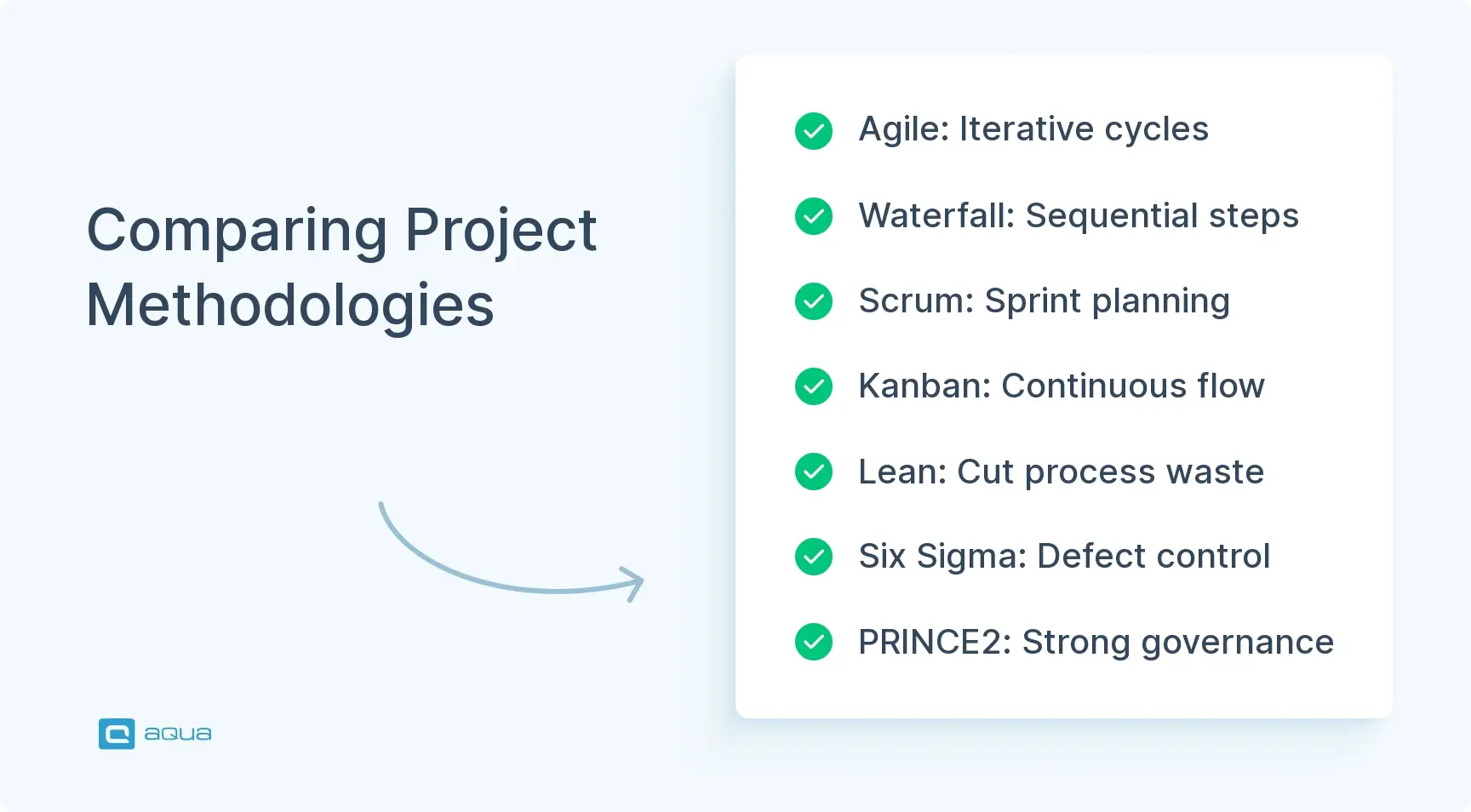
Methodologies for project management offer diverse approaches, each designed to solve specific challenges. From sequential waterfall approaches to adaptive Agile frameworks, understanding these core methodologies helps you make informed decisions about your project management process overview.
1. Agile
Method definition and origin
Agile is a family of frameworks grounded in adaptive delivery and iterative learning. The Agile Manifesto prioritizes individuals and interactions, working software, customer collaboration, and responding to change. Agile optimizes for responding to change, delivering value in increments, and shortening feedback loops.
Key components and processes
Agile methodologies in project management emphasize collaboration, working software over documentation, and empirical process control. Your teams work in short iterations, typically one to four weeks, delivering potentially shippable increments regularly. Understanding agile vs traditional testing helps your teams transition effectively.
Strengths:
- Early and frequent course correction reduces risk
- Rapid feedback loops prevent building wrong solutions
- High adaptability to changing requirements
- Strong stakeholder engagement throughout
Weaknesses:
- Requires disciplined engineering practices
- Can devolve into chaos without structure
- Demands active product ownership
- Quality suffers when automation and CI/CD are weak
Best use cases: Discovery-heavy projects with evolving requirements, software product development, innovation initiatives, teams with strong technical capabilities and mature DevOps practices. Your QA teams thrive when test automation and CI/CD are solid.
"Agile" was coined nearly 25 years ago; organizations and ways of working were very different in the 80s and 90s. Today's ways of working in virtually all companies have been deeply influenced by the ideas that sprung from the agile movement, so whether you like it or not, you'll always be working in at the very least agile inspired environment.
2. Waterfall
Method definition and origin
Waterfall is the original sequential project approach, born in manufacturing and construction, where rework carries brutal costs. The methodology flows through distinct phases: requirements, design, implementation, verification, and maintenance. Each phase cascades into the next.
Key components and processes
The framework operates on phase completion and gate approvals. Each phase must finish entirely before the next begins, with formal sign-offs ensuring stakeholder agreement. Clear milestones, predictable timelines, and excellent traceability define the Waterfall structure.
Strengths:
- Crystal-clear milestones and predictable timelines
- Excellent traceability for regulatory compliance
- Comprehensive documentation for audits
- Minimizes rework in stable-requirement environments
Weaknesses:
- Late discovery of requirement mismatches
- Expensive to pivot late in the cycle
- Limited flexibility for changing requirements
- Testing occurs late, pushing quality issues downstream
Best use cases: Regulatory projects requiring heavy documentation, infrastructure builds with stable requirements, construction projects, and medical device development. Use Waterfall when the cost of getting it wrong late justifies a heavy upfront investment in requirements clarity.
3. Scrum
Method definition and origin
Scrum is a lightweight Agile framework designed for complex product development. The Scrum Guide defines specific roles: Product Owner, Scrum Master, Developers. It establishes events such as Sprint Planning, Daily Scrum, Review, and Retrospective.
Key components and processes
Sprints are timeboxed iterations, typically two weeks, that produce potentially shippable increments. Each sprint begins with planning to determine what can be delivered and how. The Product Owner maximizes value through backlog management. The Scrum Master ensures framework adherence. Project management methodologies, Scrum implementations serve as entry points for your organization transitioning to adaptive approaches.
Strengths:
- Empirical control reduces uncertainty sprint by sprint
- Regular inspection and adaptation improve outcomes
- Clear roles and ceremonies provide structure
- Timeboxing creates a predictable delivery rhythm
Weaknesses:
- Can become a ritual checklist without true commitment
- Requires refined backlog and strong product ownership
- Technical debt accumulates without engineering discipline
- Sprint boundaries can feel artificial for some work types
Best use cases: Product teams with changing requirements, software development with active product ownership, and projects needing regular stakeholder feedback. Works best when you combine it with XP engineering practices.
4. Kanban
Method definition and origin
Kanban is a flow-based method originating from Toyota’s lean manufacturing system. Kanban visualizes work, limits work in progress, and optimizes cycle time. Unlike Scrum’s timeboxed sprints, Kanban operates continuously.
Key components and processes
The approach starts with your current process, makes it visible on a board with columns representing workflow stages, sets WIP limits to prevent overload, and measures flow metrics like lead time and throughput. Your teams pull work when capacity exists rather than pushing work according to schedules.
Strengths:
- Simple to implement and adapt
- No forced ceremonies or sprint boundaries
- Excellent for operational and support work
- Real-time priority adjustment without disruption
Weaknesses:
- Without WIP limits, it becomes a glorified to-do list
- Requires flow discipline and measurement commitment
- Can lack planning structure for complex initiatives
- Your teams may resist the constraint of WIP limits
Best use cases: Operational work like support tickets and bug triage, maintenance activities, projects with frequently shifting priorities. Combine with Scrum for sprint structure plus flow optimization.
5. Lean
Method definition and origin
Lean is a philosophy and toolkit aimed at maximizing value while minimizing waste, rooted in Toyota’s production system. Lean emphasizes delivering only what adds value, eliminating handoffs and delays, and pursuing continuous improvement through kaizen.
Key components and processes
Core principles guide implementation. Define value from your customer’s perspective. Map the value stream to identify waste. Create flow by removing obstacles. Establish pull so you build only what’s needed when needed. Your teams identify seven types of waste: overproduction, waiting, transport, overprocessing, inventory, motion, defects.
Strengths:
- Focus on value eliminates bloat
- Empowers your teams to solve problems locally
- Reduces waste and improves efficiency
- Shortens feedback loops and delivery cycles
Weaknesses:
- Requires a cultural shift from a quantity mindset
- Your teams struggle to prioritize ruthlessly
- Implementation demands leadership commitment
- Can feel cold without balancing efficiency and quality
Best use cases: Operational improvements and process optimization, product development constrained by time and budget. For your QA teams, Lean thinking means questioning every test that doesn’t reduce risk, automating repetitive checks, and shortening feedback loops.
6. Six Sigma
Method definition and origin
Six Sigma is a data-driven methodology focused on reducing defects and variation in processes. The approach aims for near-perfect quality at 3.4 defects per million opportunities using statistical tools and structured improvement cycles.
Key components and processes
The DMAIC cycle drives improvement. Define the problem and goals. Measure current performance with data. Analyze root causes using statistical methods. Improve by implementing solutions. Control to sustain gains. Six Sigma employs certification levels to build organizational capability.
Strengths:
- Rigorous root-cause analysis prevents recurrence
- Measurable, data-driven improvements
- Strong discipline around statistical validation
- Sustainable long-term quality gains
Weaknesses:
- Heavy documentation and training requirements
- Potentially slow for fast-moving projects
- Can feel overly prescriptive and bureaucratic
- Less suitable for exploratory work
Best use cases: Stable processes needing precision tuning, manufacturing quality control, operations optimization, and regulated environments requiring defect analysis. Six Sigma is deliberate and methodical, optimized for sustainable quality gains.
7. PRINCE2
Method definition and origin
PRINCE2 stands for PRojects IN Controlled Environments. This structured project management method emphasizes governance, business justification, and management by stages. Originally developed for UK government IT projects, PRINCE2 has evolved into a globally recognized standard.
Key components and processes
The framework defines clear roles. Project Board handles governance. Project Manager manages day-to-day delivery. Team Manager coordinates team activities. Seven themes run throughout your project: business case, organization, quality, plans, risk, change, progress. Each project stage requires explicit approval before the next begins.
Strengths:
- Excellent governance and accountability structure
- Clear roles eliminate confusion
- Strong business justification focus
- Scalable for large, complex programs
Weaknesses:
- Can become documentation theater if applied rigidly
- Potentially slows delivery without adding value
- Heavy for small, simple projects
- May conflict with Agile speed expectations
Best use cases: Public sector programs, large vendor engagements requiring governance, regulated initiatives where stage gates and audit trails matter. Combine PRINCE2 governance with Agile delivery inside stages for hybrid IT project management methodologies.
8. Critical Path Method (CPM)
Method definition and origin
CPM is a scheduling technique developed in the 1950s for industrial projects. The method identifies the longest sequence of dependent tasks, the critical path, which determines minimum project duration. By mapping task dependencies and durations, CPM highlights which activities have zero slack.
Key components and processes
The technique begins with comprehensive task identification and dependency mapping. Your teams estimate task durations, calculate early and late start and finish dates, and identify float for non-critical tasks. The critical path emerges as the sequence with no float.
Strengths:
- Clear visualization of bottlenecks and dependencies
- Data-driven, objective scheduling
- Identifies where delays impact completion
- Supports scenario planning
Weaknesses:
- Assumes task durations are known accurately
- Requires stable dependencies
- Can become complex for large projects
- Less effective for exploratory contexts
Best use cases: Complex, interdependent projects like construction, infrastructure builds, hardware releases. For your QA teams, CPM helps plan regression cycles, environment builds, and release pipelines where dependencies and timing matter.
9. Extreme Programming (XP)
Method definition and origin
Extreme Programming is an Agile methodology created by Kent Beck that emphasizes engineering discipline. XP intensifies software engineering practices: continuous integration, test-driven development, pair programming, refactoring, and collective code ownership.
Key components and processes
The framework includes core practices that reinforce each other. TDD ensures tests exist before code. Continuous integration catches integration issues immediately. Pair programming spreads knowledge and catches defects early. Refactoring keeps your codebases clean.
Strengths:
- Sustainable speed under constant change
- Technical excellence prevents quality erosion
- Tight feedback catches issues immediately
- Knowledge sharing through pairing
Weaknesses:
- Demands high skill and discipline
- Requires investment in tooling and training
- Pair programming can feel uncomfortable initially
- Cultural shift challenges traditional organizations
Best use cases: Software teams facing high change rates, complex domains where defect cost is high. Many high-performing QA-dev teams blend Scrum for planning cadence with XP practices for engineering rigor. Your teams implementing common software testing strategies benefit from XP’s built-in quality focus.
The Project Management Process: How to Choose the Right Methodology
Choosing the right methodology means matching your project’s constraints, risks, and team realities to a compatible operating model. Effective risk management for QA leads requires you to understand how different methodologies handle uncertainty and change.
Methodology Comparison and Selection
Different methodologies excel in different contexts. The table below provides you with a quick reference for comparing approaches across key dimensions.
Selection Framework: What to Assess
Assess Requirements Certainty
Evaluate how stable your project requirements are. High certainty with stable scope suggests predictive approaches. Low certainty with evolving scope points toward adaptive approaches.
Step 1: Evaluate Team Capabilities
Consider your team structure and maturity. Small, cross-functional teams often work well with lightweight frameworks. Large, distributed teams typically need more explicit coordination.
Step 2: Analyze Stakeholder Dynamics
Determine your stakeholder availability and preferences. Continuous engagement enables Agile frameworks. Preference for locked baselines suggests traditional approaches.
Step 3: Consider Compliance Requirements
Factor in your regulatory burden and audit needs. Heavy regulatory environments typically require more documentation and formal gates. Light compliance allows for leaner approaches.
Step 4: Factor in Risk Tolerance
Evaluate your failure costs and safety requirements. High failure cost justifies predictive approaches with stage gates. Industries like medical, aerospace, and finance often combine governance with iterative delivery.
Step 5: Measure and Iterate
Track your delivery metrics such as velocity, cycle time, and quality. Gather your team feedback on process friction regularly. Adjust methodology elements continuously based on what you learn.
Because traditional project management is rather well structured, standardized, and aligns quite well with traditional business practices. Even if "agile" is taught at IT courses, so we, as IT, can be as "agile" as we want, if the organization is not agile, that going to be really a problem.
Different project characteristics point toward different methodologies. When your requirements are stable and well-understood, Waterfall or PRINCE2 provide the structure and documentation you need. When your requirements evolve frequently, Agile frameworks like Scrum give you the flexibility to adapt. For operational work with shifting priorities, Kanban offers you continuous flow. When quality and defect reduction matter most, Six Sigma provides data-driven rigor.
| Methodology | Flexibility | Planning Style | Best For | Documentation |
|---|---|---|---|---|
| Waterfall | Low | Upfront | Stable requirements | Heavy |
| Agile | High | Iterative | Changing requirements | Light |
| Scrum | High | Sprint-based | Product development | Moderate |
| Kanban | Very High | Continuous | Operational work | Light |
| Lean | Moderate | Value-focused | Efficiency projects | Moderate |
| Six Sigma | Low | Data-driven | Quality improvement | Heavy |
| PRINCE2 | Low | Stage-gated | Governed programs | Heavy |
| CPM | Low | Schedule-driven | Complex dependencies | Moderate |
| XP | High | Iterative | Software engineering | Light |
A project management methodologies comparison reveals that each approach offers distinct advantages and limitations. While Waterfall provides clear structure and documentation, project management methodologies agile approaches offer you flexibility and faster delivery cycles.
For your technology initiatives, IT project management methodologies often require special consideration of technical dependencies and rapidly changing requirements. Organizations frequently develop hybrid project management methodologies that combine elements of different approaches. Avoiding mistakes in test management requires you to align methodology choice with your team capabilities and project constraints.
The best teams tailor frameworks rather than worship them. They measure delivery performance over ritual compliance. Modern delivery performance, measured by DORA metrics like deployment frequency and lead time, matters more than label purity.
Choosing the right project management methodology matters for your testing success, but implementing it effectively requires the right platform. aqua cloud, an AI-powered test and requirement management platform, supports every methodology discussed here. The platform provides centralized project management with custom hierarchies and automated workflows. Resource planning helps you allocate capacity across initiatives. Custom reports and KPI tracking give real-time visibility into portfolio health. Executive dashboards track progress and show where bottlenecks emerge. aqua’s domain-trained AI Copilot generates test documentation in seconds from your project artifacts. Visual mapping creates full traceability between requirements and tests. Teams save up to 15% of weekly hours through automation. The platform adapts to your methodology. Run Scrum sprints with Agile boards or manage Waterfall projects with structured documentation. aqua integrates with Jira, Azure DevOps, GitHub, Slack, plus 12+ other tools.
Boost testing efficiency by 80% with aqua's AI
Conclusion
Project management methodologies exist to match process with reality. Each approach solves specific problems and fits specific contexts. Waterfall thrives where stability matters. Agile shines when learning dominates. Hybrids blend governance with adaptability. Success comes from matching methodology to your project’s uncertainty, your team’s skills, and your organization’s constraints. Choose an approach that removes friction rather than adding ceremony, pair it with strong tooling, and keep iterating toward better outcomes.



